
If patches of St. Augustine grass are turning yellow and then brown in the hottest, sunniest parts of your Savannah yard, chinch bugs are a likely cause. UGA Extension notes the damage is often mistaken for drought. Check the edges of the patch, where green meets brown, or do a flotation test; about 20 to 25 chinch bugs per square foot is enough to cause damage. Control starts with cultural fixes — mow about 3 inches high and switch summer feeding to slow-release nitrogen at half rate — and, when counts are high, a labeled insecticide, which may need two applications two to three weeks apart (UGA Circular 1147; UGA Extension fact sheet).
Why Savannah St. Augustine lawns see chinch bugs
St. Augustine is one of the main warm-season lawns on the Georgia coast, along with centipede, zoysia and bermuda (see best grass for Savannah lawns). UGA's chinch bug guidance focuses on St. Augustine. The insects favor hot, sunny spots, and Savannah has plenty of heat: the airport's July average high is 92.3 °F, and the area averages 80.5 days a year at or above 90 °F (NOAA 1991–2020 normals). Open areas in full sun — away from the shade of live oaks — are where to look first.
Chinch bug damage or a dry lawn?
The two look alike, which is why UGA warns that chinch bug damage is often taken for drought. Before you change anything, rule out water. UGA's guideline is about 1 inch a week from rain plus irrigation, applied early in the morning and wetting the soil 5 to 7 inches deep (UGA). If a patch keeps yellowing and browning even though the lawn is getting that much water, and especially if the patch sits in full sun, look for insects.
Savannah's watering rules shape how you deliver that inch. The City allows no outdoor irrigation from 10 a.m. to 4 p.m. and none on Fridays; even-numbered addresses water Monday, Wednesday and Saturday, odd-numbered addresses Tuesday, Thursday and Sunday. The Savannah watering schedule guide covers the details and exemptions.
How to check for chinch bugs
Look at the edge of the patch
UGA advises checking the edges of damaged patches rather than the middle. Kneel at the edge where yellow meets green, part the grass with your fingers and look down at the soil surface and the base of the runners. The bugs are small, so take your time and check several spots.
Try a flotation test
UGA describes a flotation test as the other way to confirm them. The usual approach is to push a metal can with both ends removed a couple of inches into the turf at the edge of a patch, fill it with water, and watch for several minutes as insects float to the surface. Repeat in a few places. UGA's damage threshold is about 20 to 25 chinch bugs per square foot; if you are finding far fewer, the problem may be something else.
Cultural fixes come first
UGA's cultural recommendations are simple and cost little:
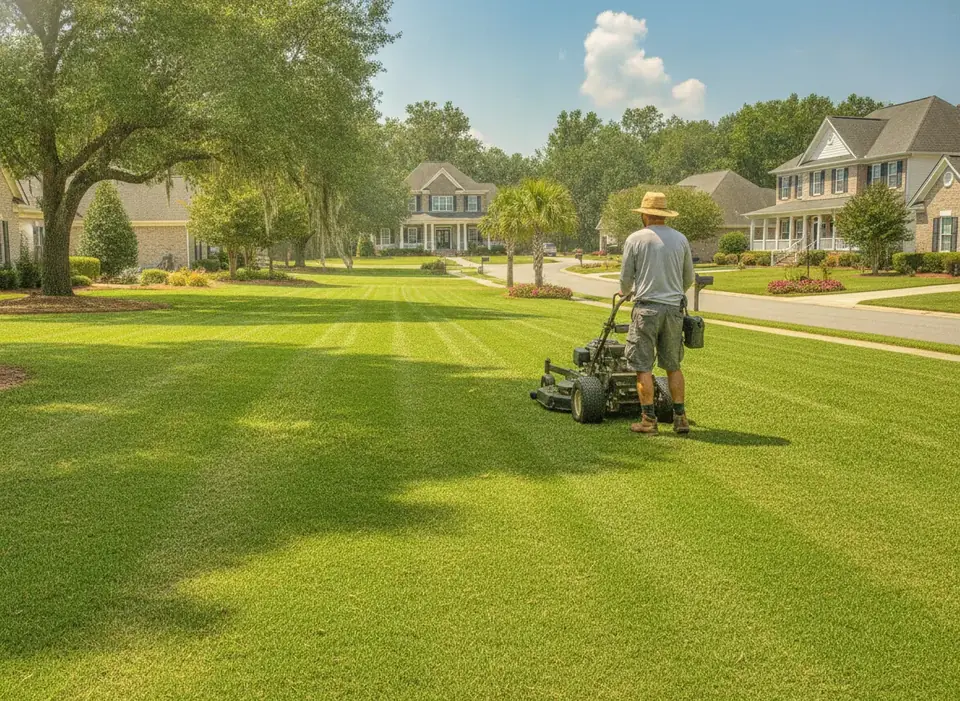
- Mow higher. UGA's coastal guidance for St. Augustine is 2 to 3 inches, and about 3 inches in chinch bug season. Raise the deck about half an inch in hot weather and never remove more than one-third of the blade at once (UGA Glynn County Extension; UGA).
- Ease off summer nitrogen. Use a slow-release nitrogen fertilizer at half rate during summer rather than a quick, heavy feeding.
- Water deeply, not daily. About an inch a week, in the early morning, on your allowed days.
When an insecticide makes sense
If counts are at or above the threshold, a labeled insecticide is the next step. UGA notes that two applications two to three weeks apart may be needed, so plan to recheck the patch edges after the first round. Use a product labeled for chinch bugs on St. Augustine and follow the label for rate, timing and watering-in. Treating the whole lawn by default is not the goal; the inspection tells you where the problem is.
Hiring a company for chinch bugs
Many Savannah homeowners hand this to a company that already handles their weed control and fertilization, or ask their lawn mowing service to raise the cutting height for summer.
Georgia license check. In Georgia, a business that applies pesticides — including weed killers, weed-and-feed, insect, fire ant or mosquito treatments — to someone else's property for a fee needs a Pesticide Contractor License from the Georgia Department of Agriculture, with a certified commercial applicator on staff (O.C.G.A. § 2-7-99). Lawn and shrub work falls under applicator Category 24 (Ornamental and Turf); mosquito control is Category 41. Ask for the license number and check it with the Georgia Department of Agriculture. Treatments around the home's foundation fall under Georgia's Structural Pest Control Act — ask for the company's structural pest control license.
This is general information, not legal advice.
Questions worth asking:
- Will you inspect and count before treating, or treat on a schedule?
- If a second application is needed two to three weeks later, is it included?
- What mowing height and summer fertilizer rate do you recommend for St. Augustine?
- What is your Georgia Department of Agriculture pesticide contractor license number?
No reliable local average was published for insect or weed control applications in Savannah — get two or three quotes. Price usually depends on lawn size, how many visits are needed and whether it is part of an ongoing plan.
Repairing patches that don't recover
Once the infestation is under control, some damaged areas may fill back in and some may not. Homeowners with large dead areas often patch them with new St. Augustine sod. Published cost guides put installed sod at about $1 to $3 per square foot, with the sod itself about $0.35 to $0.60 per square foot — typical ranges from published cost guides (2026), estimates, not quotes. See sod installation in Savannah and the full Savannah landscaping and lawn care prices page.
The short version
Yellow-to-brown patches in sunny St. Augustine during a Savannah summer may be chinch bugs, not drought. Confirm with an edge check or flotation test, mow about 3 inches high, cut summer nitrogen to a half rate of slow-release, and use a labeled insecticide only when counts justify it.
We connect Savannah-area homeowners with independent local lawn care, landscaping and tree companies for free, no-obligation quotes. The company you choose quotes, contracts and does the work directly with you. Request a free quote and compare two or three before you decide.