
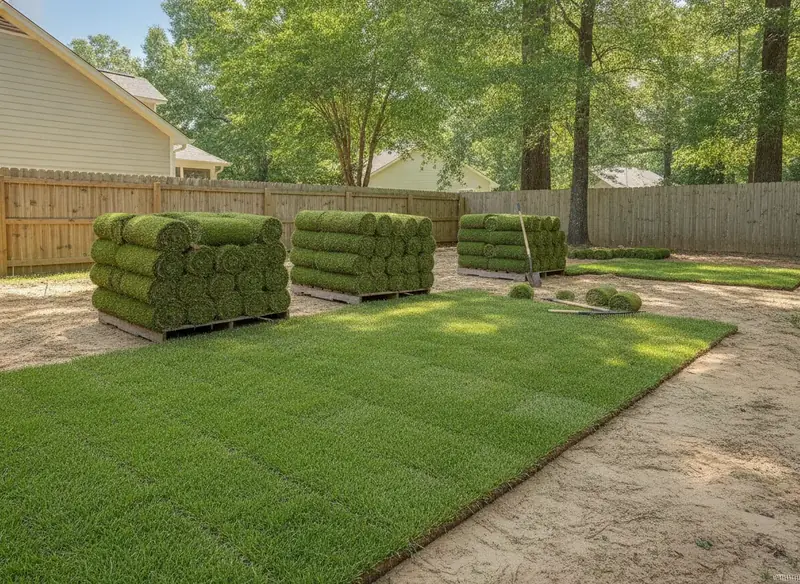
For most Savannah yards, the right lawn is a warm-season grass: centipede, St. Augustine, zoysia or bermuda. These four are the main lawns on the Georgia coast. Centipede suits sunny lawns where you want low fertilizer needs, St. Augustine and zoysia handle more shade under oaks and pines, bermuda wants sun and frequent mowing, and seashore paspalum is the pick for salty, marsh-front sites. The choice comes down to sun, salt, soil and how much care you want to give the lawn.
What Savannah's climate asks of a lawn
Savannah is hot, humid and wet. NOAA's 1991–2020 normals for Savannah/Hilton Head International Airport show 48.12 inches of rain a year, 80.5 days a year at or above 90 °F and a July average high of 92.3 °F (NOAA annual normals). Summer rain is heavy: June through September brings 22.21 inches, about 46% of the year's total. The median last spring freeze is March 2 and the median first fall freeze is November 30, giving a freeze-free season of about 270 days.
That long, hot season is why warm-season grasses dominate the coast. They green up in spring, grow hard through summer and go dormant and tan after the late-fall freezes. Cool-season grasses common in north Georgia are a poor fit here.
Savannah soils: sandy, acidic and often wet
Most of the land in Bryan and Chatham Counties is mapped by the USDA Natural Resources Conservation Service as poorly or very poorly drained. Ellabelle, one of the most common soils, is described as having a water table "at or near the surface for more than 5 months each year" and being strongly to very strongly acid (NRCS soil description). Pockets of deep, excessively drained sand dry out fast. Coastal sands are also low in fertility and leach nitrogen. A soil test through UGA Extension is the honest first step before you choose a grass or add lime.
Comparing the four main coastal lawns
| Grass | Mowing height (UGA) | Good fit when… | Watch for |
|---|---|---|---|
| Centipede | 1–2 in. (C 1003: 1.0–1.5 in.) | Sunny to lightly shaded lawns; you want a lower-input lawn | Decline from too much fertilizer or lime |
| St. Augustine | 2–3 in. | Yards with some shade from oaks or pines | Chinch bugs in hot, sunny spots |
| Zoysia | 1–2 in. | You want a dense lawn and some shade tolerance | Large patch in fall and spring |
| Bermuda | Common 1–2 in.; hybrid 1–1.5 in. | Full-sun lawns and play areas | Needs frequent mowing in summer |
Mowing heights are from UGA Extension in Glynn County, a coastal county, and UGA Circular 1003. UGA also advises raising the mower about half an inch in hot weather and never removing more than one-third of the blade at once (UGA).
Centipede
Centipede's main appeal is how little it asks: UGA says about 1 pound of nitrogen per 1,000 sq ft per year is ample for most established centipede, up to 2 pounds on sandy, high-rainfall soils. It also prefers acidic soil, with a pH of about 5.0 to 6.0, which suits many native coastal soils. Above 6.0, iron becomes less available and the grass yellows (UGA C 1003, Centipedegrass Decline). The catch is that centipede punishes over-care: heavy fertilizing and unneeded lime are linked to centipede decline. Our full centipede grass care guide has the calendar.
St. Augustine
St. Augustine is a coarse, broad-bladed grass mowed tall, 2 to 3 inches. Along with zoysia, it is usually a better choice than seashore paspalum for yards with heavy tree shade. Its most notorious pest is the chinch bug, which causes yellow-to-brown patches in hot, sunny areas that are often mistaken for drought. See our guide to chinch bugs in St. Augustine before you assume a brown patch needs more water.
Zoysia
Zoysia forms a dense lawn mowed at 1 to 2 inches and is one of the better shade choices on the coast. It is one of the grasses UGA lists as prone to large patch, the brown rings that show up in fall and spring when soils are cool and wet. Read up on large patch lawn disease if your yard drains slowly.
Bermuda
Bermuda is a sun-lover mowed low, 1 to 2 inches for common types and 1 to 1.5 inches for hybrids. It fits open, sunny yards. Under live oaks and pines, ask a sod supplier or lawn company whether your yard gets enough sun before choosing it.
Salt and marsh-front lots: seashore paspalum
Homes on Wilmington Island, Tybee and other marsh-front lots can face salt spray and salty irrigation water. UGA's turfgrass breeding program describes seashore paspalum as the most salt-tolerant warm-season turf and well adapted to "moist and salt-affected areas commonly found in coastal regions" (UGA turfgrass breeding). It is a specialty choice, so ask local suppliers about availability and care before you commit.
Questions to answer before you choose
- How many hours of direct sun does the lawn get? Shade from oaks and pines narrows the list quickly.
- Is the site salty? Marsh-front and island lots may need a salt-tolerant grass.
- How wet is the yard after summer storms? Slow-draining spots invite fungus whatever you plant.
- How often will it be mowed? Bermuda and zoysia look their part with regular, low mowing; centipede is more forgiving.
- What does the soil test say? pH and nutrient levels shape fertilizer and lime decisions.
- What does your HOA require? Some neighborhoods set lawn standards.
Switching grasses: sod and timing
Most coastal lawns are established from sod. Published cost guides put installed sod at about $1–$3 per sq ft, with the sod itself about $0.35–$0.60 per sq ft (typical ranges from published cost guides (2026) — estimates, not quotes). See the Savannah landscaping prices page for more ranges. New sod is exempt from Savannah's watering schedule during installation and for 30 days after, as explained in our Savannah watering schedule guide.
Companies that offer sod installation in Savannah can help match a grass to your sun and soil, and companies that offer lawn mowing or weed control and fertilization can keep it on the right program once it is down.
Get quotes for a new lawn
We connect Savannah-area homeowners with independent local lawn care, landscaping and tree companies for free, no-obligation quotes. The company you choose quotes, contracts and does the work directly with you. Tell us about your yard and request a free quote for sod, mowing or lawn care.